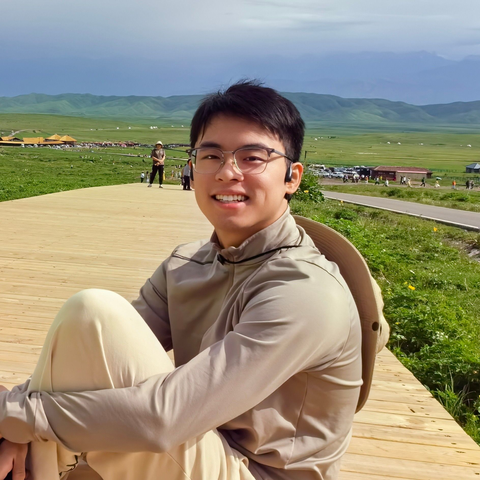
PhD student in Computer Science
About Me
I am a first-year PhD student in Computer Science at Vanderbilt, supervised by Dr. Yuankai Huo. My current research interest lies on AI for Healthcare, where I am particularly interested in leveraging artificial intelligence to optimize clinical workflows and improve diagnostic accuracy. Before joining Vanderbilt, I received my B.Eng. degree in Biomedical Engineering from Southern University of Science and Technology (SUSTech) in 2026. At SUSTech, I worked in the Contactless Healthcare Lab under the supervision of Dr. Wenjin Wang, focusing on the applications of remote photoplethysmography (rPPG). Outside of research, I enjoy playing badminton and am trying tennis.
E-mail: yiming.zhong@vanderbilt.edu
Last updated: September 24, 2026
- AI for Healthcare
- Computer Vision
- Medical Image Analysis
Ph.D. in Computer Science
Vanderbilt University, Nashville, TN, USA
B.Eng. in Biomedical Engineering
Southern University of Science and Technology (SUSTech), Shenzhen, China
Exchange student
Nanyang Technological University (NTU), Singapore


Education
Ph.D. in Computer Science
Vanderbilt University, Nashville, TN, USASupervised by Dr. Yuankai Huo. Research on computer vision.B.Eng. in Biomedical Engineering
Southern University of Science and Technology (SUSTech), Shenzhen, ChinaCumulative GPA: 3.79/4.0 | Weighted Average Score: 90.68/100
Thesis on AI for healthcare. Supervised by Dr. Wenjin Wang. Presented papers at 2 IEEE conferences (1 in EMBC and 1 in BHI), and 1 TBME journal paper is under review.
Courses included:
- Big Medical Data
- Biomedical Optics
- Principle of Biomedical Imaging
Exchange student
Nanyang Technological University (NTU), SingaporeCourses included:
- Control in Biosystem
- Machine Learning & Optimization for Bioengineers
Every heartbeat changes the blood flow in the vessels of your face, which slightly changes the intensity of the light reflected by your skin. By capturing these changes with your camera, we calculate your heart rate. This technique is called remote photoplethysmography (rPPG).
The demo runs the rPPG algorithms used in the Contactless Healthcare Lab led by Dr. Wenjin Wang at SUSTech, entirely in your browser. For details, see Algorithmic Principles of Remote PPG (Wang et al., IEEE TBME, 2017).
Your video never leaves this device. All processing happens locally in the browser, and nothing is uploaded or stored.
Pulse signature of your camera
PriorHow strongly your pulse shows up in each colour channel, learned live for your camera and lighting and used by PBV and DIS. Ticks mark the default.
Pulse spectrum (last 10 s)
Spectrogram (last 60 s)
For illustration only, not a medical device. Lighting, skin tone, camera quality and movement all affect accuracy.
Ported from the MATLAB code of my undergraduate research at SUSTech. Face detection by MediaPipe.


